The Companies Act, 2017 sets the foundation of the corporate sector and capital market of Pakistan which is regulated by the Securities and Exchange Commission of Pakistan (SECP).
For limited setups, the Act offers following registrations:
- Single Member Company (SMC)
- Private Limited Company
- Public Limited Company
- Section 42 (we have published dedicated blog on it)
In fact, SMC is a private limited.
Foundational difference between private and public companies
The scheme of these companies is same i.e. a CEO, shareholders and directors. The difference lies in number of shareholders and ability to get finance from public.
- An SMC is a sole owner and sole director company. Both persons must be the same.
- Private company must be registered with only 2 persons.
- A public company can be setup with minimum 3 persons. But if a public company becomes listed, the minimum number of directors will be raised to 7.
- SMC and Private company can’t get equity and debt finance from general public.
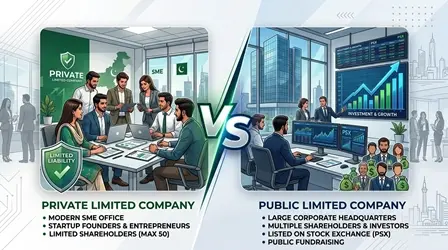
Private Limited vs Public Limited Company
| Features | Private Limited | Public Limited |
| Equity finance | Usually, company founders and family members provide equity finance | From public at large provides equity finance |
| Minimum members | Two (2) | Three (3) |
| Maximum members | 50 (fifty) | No limit |
| Transfer of shares | Shareholders are not allowed to sell shares to general public. | Transfer of share is not restricted. Shareholders and general investors have option to trade listed shares freely. |
| Public investment (both equity and debt) | Not allowed | Public companies can invite public for shares, debentures, units and bonds etc., but subject to respective rules and regulations. |
| Stock exchange listing | Not allowed | Allowed subject to the Securities Act 2015 and PSX listing regulations and other respective rules. |
| Compliances | Minimal requirements and cost | Public listed company has additional compliances as compared to an unlisted public company. |
| Management | Usually, owners manage their private companies themselves. | Ownership and management may not be same. |
| Annual filing with SECP | Required | Required |
| Annual auditor appointment | Required subject to threshold of paid-up share capital which is Rs. 10 million. | Straightaway required. There is no threshold of paid-up share capital. |
| Accounting framework | IFRS | International Financial Reporting Standards (IFRS) |
| Audit committee | Not required | Mandatory |
| Corporate Governance | Not required | Mandatory |
| Liability of Members | Limited to the extent of any amount, if any, unpaid on the shares held by them. | Limited to the extent of any amount, if any, unpaid on the shares held by them. |
| Recommended for | SMEs, startups and family-owned businesses | Multi-nationals, international and large businesses |
| When to Choose this structure | You are in a startup phase. You are growing but don’t want to get investments from public at large. | You are growing and want to scale it up by getting public investments or you have a plan in near future to reach out public. |
Note: A public company has two appearance one is unlisted and other is unlisted. Upon registration with SECP, a this setup is unlisted by default. When it moves towards stock market, it has to be listed.
Bonus – How to register in Pakistan
Step 1 – Decide your business model.
Step 2 – Get name reserved with SECP.
Step 3 – Complete necessary documentation.
Step 4 – Proceed process of registration on SECP eZfile portal.
Step 5 – Get registrar approval.
Step 6 – Get the incorporation certificate.
We have already published a dedicated blog on registration of company in Pakistan.
Recommendation
Start from a private company. Once, your business grows, your business acumen increases. Then you better understand compliances. I recommend to move on towards public company setup over the time.
But if you are an already established multi-national, you can setup a public company in Pakistan since you have resources (team, experience) to run and manage the setup.
Private limited company is easy to manage.
Legal Reference
Companies Act 2017