Published on 5 October 2026
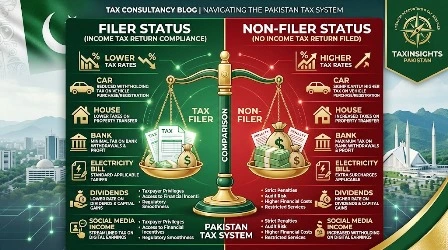
In Pakistan, taxpayers pay taxes on most common transactions like purchase and sale of motor vehicle, purchase and sale of immoveable property, payment of dividends and banking transactions etc.
I am giving a comparison filer and non-filer taxes for these transactions and arrangements. Let’s take a look at it.
Table of Contents
- Advance Tax on Dividends
- Tax on Issue of Bonus shares
- Advance Tax on Sales to Retailers
- WHT rates on Income from rental of immoveable property
- Income from social media
- Prize bonds, winnings and other prizes under section 256
- Cash Withdrawals from bank accounts under section 231AB
- Advance Tax on Private Motor Vehicles (Section 231B)
- Brokerage and commission
- Sale by auction under Section 236A
- Advance tax on electricity consumption by domestic consumers
- Advance tax on purchase of immoveable property
- Advance tax on sale / transfer of immoveable property
- Important to note
- Legal references
- Disclaimer
If you are looking for a guide on filer registration, I have published a detailed and dedicated blog on it.
Advance Tax on Dividends
Tax on dividends under Section 150 and Division I of Part III of the First Schedule
| Sr. No | Description | Filer | Non-Filer |
| 1 | Dividend paid by IPPs under the Implementation Agreement, the Power Purchase Agreement or Energy Purchase Agreement and is required to be reimbursed by the Central Power Purchasing Agency. | 7.5% | 15% |
| 2 | Dividend in case of Mutual Fund (contingent upon proportional income derived from average annual investments in debt securities) | 25% | 50% |
| 3 | Dividend in case of Mutual Fund (contingent upon proportional income derived from average annual investments in equities). | 15% | 30% |
| 4 | Dividend received by REIT from special-purpose vehicles | 0% | 0% |
| 5 | Dividend received by others from special purpose vehicles as defined under Real Estate Investment Trust Regulation, 2015 | 35% | 70% |
| 6 | Dividend in case of Real Estate Investment Trusts, listed shares and all other cases | 15% | 30% |
| 7 | Dividend if no tax is payable by the company due to the exemption/ carry forward of loss or tax credits | 25% | 50% |
Tax on Issue of Bonus shares
Instead of issuing dividends, a company may issue bonus shares in proportion to the existing shareholding. Under the Section 236Z, there are different rates for filer and non-filer on issuance of such shares:
Filer: 10% withholding tax on the value of bonus shares.
Non-Filer: 20% withholding tax on the value of bonus shares.
For example:
Let’s say, a shareholder receives bonus shares worth PKR 100,000, so the taxes will be:
- Filer: Tax deducted Rs. 10,000/-
- Non-Filer: Tax deducted Rs. 20,000/-
Advance Tax on Sales to Retailers
The Section 236H charges different rates on sales to retailers. The advance tax is charged on the gross value of sales made to retailers:
- Filer: 0.5%
- Non-Filer: 2.5%
WHT rates on Income from rental of immoveable property
Section 15 defines rental income from immoveable property and Section 155 specifies withholding taxes on the income.
A person may have immoveable properties like flat, house, plaza, any other building and parking place or open land etc. from where that person is getting rent.
Under the Section 15, if property owner is getting rentals of plant and machinery or any amount in lieu of utilities or maintenance charges, these amounts will be included in income from other source.
Furthermore, rent from agricultural land is exempt from tax.
Section 155 specifies the different tax withholding rates on rental income of filer and non-filer property owners. Tenants will deduct income tax at following rates from the gross payments of rent.
| Gross Rentals (Rupees) | Filer | Non-Filer |
| 0 to 300,000 | 0% | 0% |
| 300,001 to 600,000 | 5% of amount exceeding Rs. 300,000/- | 10% of amount exceeding Rs. 300,000/- |
| 600,001 to 2,000,000 | Rs. 15,000/- + 10% of exceeding Rs. 600,000/- | Rs. 30,000/- + 20% of exceeding Rs. 600,000/- |
| Exceeding Rs.2,000,000 | Rs. 155,000/- + 25% of exceeding Rs. 2,000,000/- | Rs. 310,000/- + 50% of exceeding Rs. 2,000,000/- |
The withholding rates on rent are for individuals and AOPs.
Below rates are for the companies.
- Filer: 15% on gross amount
- Non-Filer: 30% on gross amount
Remember: Tenants are responsible to submit the deducted tax in government treasury.
Income from social media
Now a days, Pakistani freelancers, content creators and bloggers are getting payments of Google Ads, Meta (from monetization of content), TikTok, YouTube and many others.
Through the newly inserted Section 154B, the Finance Act 2026 has empowered banks to deduct withholding tax on revenue received from social media platforms at these rates:
- Filer: 5%
- Non-Filer: 10%
After tax deduction, content creators will get net payment in their bank accounts.
Prize bonds, winnings and other prizes under section 256
| Prizes | Filer | Non-Filer |
| Prize on Prize Bond & crossword puzzle | 15% | 30% |
| Winnings from a raffle, lottery, prize on winning a quiz, prize offered by a company for promotion of sales | 20% | 40% |
Cash Withdrawals from bank accounts under section 231AB
| Limit on cash withdrawal | Filer | Non-Filer |
| Cash withdrawal exceeding Rs. 50,000 in aggregate in a day | 0% | 0.8% |
Advance Tax on Private Motor Vehicles (Section 231B)
Section 231B specifies taxes on purchase, registration and transfer of motor vehicles (Division VII, Part IV, 1st Schedule)
Purchase and Registration of vehicle
The taxes on purchase and registration of motor vehicles are:
| Engine Capacity | Filer | Non-Filer |
| Up to 850cc | 0.5% of the value | 1.5% of the value |
| 851cc to 1000cc | 1% of the value | 3% of the value |
| 1001cc to 1300cc | 1.5% of the value | 4.5% of the value |
| 1301cc to 1600cc | 2% of the value | 6% of the value |
| 1601cc to 1800cc | 3% of the value | 9% of the value |
| 1801cc to 2000cc | 5% of the value | 15% of the value |
| 2001cc to 2500cc | 7% of the value | 21% of the value |
| 2501cc to 3000cc | 9% of the value | 27% of the value |
| 3000cc and above | 12% of the value | 36% of the value |
Explanation:
You bought a car of 800 CC from a show room and you are filer. You will pay 0.5% of buying price of the car.
On the other side, if you bought this car from a private seller, you will pay 0.5% of consideration paid at time of transfer of registration at your name.
Practically, the excise department collect this tax at time of registration from the purchaser.
Note:
In case where engine capacity is not applicable and value of vehicle is Rs 5 million or more, the rate of tax collectible will be 3%.
Transfer of vehicle
Under Section 231B, the tax rates on the transfer of vehicles are:
| Engine Capacity | Filer | Non-Filer |
| Up to 850cc | – | – |
| 851cc to 1000cc | 5,000 | 15,000 |
| 1001cc to 1300cc | 7,500 | 22,500 |
| 1301cc to 1600cc | 12,500 | 37,500 |
| 1601cc to 1800cc | 18,750 | 56,250 |
| 1801cc to 2000cc | 25,000 | 75,000 |
| 2001cc to 2500cc | 37,500 | 112,500 |
| 2501cc to 3000cc | 50,000 | 150,000 |
| 3000cc and above | 62,500 | 187,500 |
Note:
When engine capacity is not applicable, and the value of vehicle is Rs. 5 million or more, the rate of tax collectible will be Rs. 20,000/-.
The rate of transfer tax to be collected is reduced by 10% each year from the date of first registration in Pakistan.
Sale of a locally manufactured vehicle before its first registration
Section 231B (2A) – A person buys a locally manufactured motor vehicle from manufacturer and sells it before its first registration, then the taxes are:
| Engine Capacity | Filer | Non-Filer |
| Up to 1000cc | 100,000 | 300,000 |
| 1001cc to 2000cc | 200,000 | 600,000 |
| 2001cc and above | 400,000 | 1,200,000 |
Brokerage and commission
Under the Section 233 and the Division II of the Part IV of the First Schedule of the Income Tax Ordinance 2001, persons receiving commission or brokerage as income are liable to pay withholding income tax at following rates:
| Services | Filer | Non-Filer |
| Advertising agents | 10% | 20% |
| Life Insurance Agents where commission received is less than Rs. 500,000 per annum | 8% | 16% |
| Persons not covered in 1 and 2 above | 12% | 24% |
Sale by auction under Section 236A
There are certain auction transactions where the different rates are applicable on the sale price.
| Transactions | Filer | Non–Filer |
| Sale of immovable property | 5% | 10% |
| Sale of Goods other than immovable property | 10% | 20% |
| LEASE OF COLLECTION RIGHTS (Fee or Other Levies and Toll) | 110% | 20% |
Let say, a person sells its house at auction at Rs. 12 million. It will get net amount after deduction of tax at applicable rate. The auctioneers will deduct this tax and deposit it in Govt treasury.
Advance tax on electricity consumption by domestic consumers
Section 99A, 235 and 235(1A) specifies different rates for domestic consumers of electricity. It depends upon the monthly bill threshold.
| Monthly bill threshold | Filer | Non-filer |
| Monthly bill up to Rs. 25,000 | 0% | 0% |
| Monthly bill exceeding Rs. 25,000 | 0% | 7.5% |
Advance tax on purchase of immoveable property
The Section 236K specifies different taxes depending upon fair market value of immoveable property like plot, flat, plaza and house etc. There is no tax on inheritance.
| Fair Market Value (FMV) | Filer | Non–Filer |
| FMV does not exceed Rs. 50 million | 1.25% | 10.5% |
| FMV exceeds Rs. 50 million but it does not exceed Rs. 100 million | 1.25% | 14.5% |
| FMV exceeds Rs. 100 million | 1.25% | 18.5% |
Advance tax on sale / transfer of immoveable property
Section 236C sets following rates on sale and transfer of immoveable property.
| Consideration | Filer | Non–Filer |
| Gross Amount of Consideration Received | 2.75% | 11.5% |
Important to note
Annual income tax rates (when you file your annual tax return with FBR) at your taxable income are same whether you are earning:
- Salary
- Rent
- Business
- Capital Gain tax on sales of IMP
- Capital Gain tax on sales of securities
- Income from any other source
Some with holding and advance taxes are final and some are adjustable. Final means that the taxes can’t not be credited against your payable income tax. On the other side, you can claim adjustable taxes.
Adjustable taxes are:
- Advance tax paid on purchase, transfer and sale of immoveable property
- Advance tax paid on purchase, transfer and sale of motor vehicles
- Taxes deducted by banks on cash withdrawal
- Taxes deducted from retailers under section 236H
Legal references
- Income Tax Ordinance 2001 (updated up to 30 June 2026)
- Relevant rules, regulations and SROs
- Pakistan Federal Finance Act 2026
Disclaimer
This blog is for informational purpose only. The content of this blog is based on the Income Tax Ordinance 2001 (updated 30 June 2026), Finance Act 2026 and other relevant SROs along with rules and regulations.
Tax laws change from time to time, and the applicability of a rule may vary depending on individual circumstances.
This content should not be treated as professional tax advice. For specific guidance, please consult a qualified tax professional or refer to the latest notifications issued by the Federal Board of Revenue