
Updated: 4 October 2026
Learn how to register with FBR, obtain an NTN, file your tax return, and become an active taxpayer in Pakistan.
Ahmad had just finalized a property transaction when he received an unexpected surprise. The taxes deducted from his payment were significantly higher because he was classified as a non-filer.
Become a Tax Filer in Pakistan Without the Hassle
Need help with NTN registration or income tax return filing? Our tax professionals handle the entire process for individuals, freelancers, salaried persons, businesses, and overseas Pakistanis.
Like many Pakistanis, he had heard the term “filer” countless times. Banks mentioned it. Property dealers emphasized it. Car dealerships asked about it. But he had never taken the time to understand what becoming a filer actually involved.
Table of Contents
- Become a Tax Filer in Pakistan Without the Hassle
- Key Takeaways
- Who Is a Filer in Pakistan?
- What is Active Taxpayers’ List?
- Why Should You Become a Filer in Pakistan?
- Who Should Become a Filer?
- What Documents Are Required to Become a Filer?
- List of Documents required for Salary Individual
- List of Documents required for pensioners
- List of Documents required for self-employed and business persons
- List of Documents required for home owners
- List of Documents required for stock market investors
- List of Documents required for overseas Pakistanis
- Step-by-Step Guide: How to Become a Filer in 2026
- How to File Your Income Tax Return on IRIS 2.0
- Adjustable and refundable taxes
- Deadline for submission of Income Tax Return for FY 2025-26
- ATL Surcharge and Penalties for late filing
- How to Check Your Filer Status
- How Long Does It Take to Become a Filer?
- Common Mistakes New Filers Make
- Expert Tips and Best Practices
- What Happens After You Become a Filer?
- Latest 2026 Updates
- Final Thoughts
- Legal references:
- Disclaimer:
- Frequently Asked Questions
The good news is that becoming a filer in Pakistan is much easier than most people think. You no longer need to visit government offices, stand in long queues, or deal with excessive paperwork. Most of the process can be completed online through the Federal Board of Revenue (FBR) IRIS 2.0 portal.
Whether you are a salaried employee, freelancer, business owner, property investor, consultant, e-commerce seller, or overseas Pakistani, becoming a filer can help you reduce taxes, improve financial credibility, and stay compliant with Pakistan’s tax laws.
In this guide, you’ll learn exactly how to become a filer in Pakistan in 2026, the documents you’ll need, common mistakes to avoid, and what happens after submitting your first tax return.
Key Takeaways
- Becoming a filer means to have an NTN and to have filed your income tax return within due date to appear on Active Taxpayer List (ATL).
- From 1st July 2026, FBR has increased amounts of ATL surcharge for individuals, AOPs and companies.
- For individuals and AOPs, FBR has extended the due date of filing of income tax returns for the FY 2025-26 to 15th October 2026.
- If you miss the deadline, you will pay higher amount of ATL i.e. Rs. 25,000 for individual taxpayers and Rs.50,000 for AOPs.
- Filers pay lower rates of tax on property sale and purchase, banking transactions and vehicle registration.
Who Is a Filer in Pakistan?
A filer is a person or business that submits an income tax return to FBR and appears on the Active Taxpayer List (ATL).
Being a filer does not necessarily mean you pay large amounts of tax. In fact, many individuals file tax returns even when their tax liability is minimal.
To qualify as a filer, you must:
- Register with FBR and obtain an NTN
- Submit your income tax return
- Fulfill reporting obligations
- Pay any due taxes
- Also pay ATL surcharge for becoming filer
Many people mistakenly believe that obtaining an NTN automatically makes them a filer.
It doesn’t.
An NTN is only your taxpayer identification number. You become a filer only when a tax return is successfully submitted and your name appears on the ATL.
What is Active Taxpayers’ List?
FBR maintains a list of taxpayers who are filing their tax returns timely. This list is Active Taxpayers’ List. ATL has contributed towards digitization and documentation of Pakistan’s economy.
You are going to buy property, the relevant Govt department checks your status on ATL at time of property transfer. Of course, taxes vary for filer and non-filer.
Why Should You Become a Filer in Pakistan?
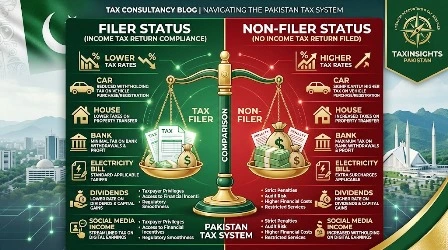
The biggest reason to become a filer is to reduce excessive withholding taxes and maintain legal compliance.
Pakistan’s tax system imposes higher rates on non-filers across multiple transactions.
A Comparison of Most Common Taxes for Filer and Non-Filer
| Transaction | Filer | Non-Filer |
| Property transfer or sale | 2.75% | 11.5% |
| Vehicle registration | 0.5% to 12% depending on engine capacity | 1.5% to 36% depending on engine capacity |
| Cash Withdrawal from bank account | 0% | 0.8% |
| Purchase of house, plot and flat | 1.25% | 10.5%, 14.5% and 18.5% depending on the fair market value of the property |
We have already published a dedicated blog on the comparison of taxes for filer and non-filer.
Benefits of becoming a filer
After the comparison of taxes, it is obvious that becoming a filer offers several benefits. Along with it, you can avail additional benefits on appearing in ATL.
- Improved financial profile
- Easier loan processing
- Better business credibility
- Compliance with tax laws
- Reduced taxes on transactions
- Improved record keeping
Who Should Become a Filer?
Almost every individual earning income in Pakistan should evaluate whether tax registration and filing are necessary. This includes:
| Persons | Explanation |
| Salaried employees | If you receive salary income from an employer, filing tax returns helps maintain compliance and often prevents future tax complications. |
| Freelancers | Freelancers working on platforms such as Upwork, Fiverr, Freelancer.com, PeoplePerHour, and Toptal should properly report their income. |
| Sole businesses | Sole traders, retailers, wholesalers and shop owners constitute undocumented economy of Pakistan. FBR is actively chasing them. |
| Business owners | These tax payers hold controlling interests in multi-nationals and own business empires. FBR considers them as larger tax payers. |
| Property investors | Regular property transactions often involve significant withholding taxes on sale and purchase. Filer status can reduce these costs. |
| Consultants and professionals | This category accommodates doctors, lawyers, architects, engineers, marketing consultants and IT professionals. |
| SMEs and corporates | It constitutes single member companies, private limited companies, family-owned businesses, public companies and multi-nationals. |
Ready to Enjoy the Benefits of Being a Tax Filer?
From lower withholding taxes to easier banking and business transactions, becoming a filer can save you money. Let us handle your tax return filing professionally.
What Documents Are Required to Become a Filer?
Before starting the NTN registration process, prepare the following information.
- Valid CNIC and NICOP
- Active mobile number
- Personal email address
- Residential address
- Address of business
Once this information is available, registration on IRIS portal can be completed with ease. Upon creation of IRIS login ID, FBR issues National Tax Number (NTN) to the taxpayer automatically.
List of Documents required for Salary Individual
- Salary slips
- Certificate by employer for the deduction of tax at source on salary
- Bank statements of salaried and saving accounts
- Records of expenses (children school fee, telephone, internet, utilities etc.)
- Any additional source of income (prize bonds, rent, bank profits, stock market investments, pension funds etc.)
List of Documents required for pensioners
- Pension slips
- Tax deduction certificates for the deduction on bank profits, behbood or saving accounts, prize money on prize bonds etc.
- Bank statements of pensioner and saving accounts
- Records of expenses (personal, telephone, internet, utilities etc.)
- Any other source of income other than pension, rent and saving accounts.
List of Documents required for self-employed and business persons
- Bank statements (personal and business)
- Record of business expenses like payroll, office rent, utilities, supplier payments etc.
- Details of business assets and liabilities (bank loans, business loans)
- Details of personal assets
- Any side hustles and investments
List of Documents required for home owners
- Rent agreements
- Receipts of property tax paid
- CPRs of tax withheld (on rental payments) by tenants
- Bank statements for confirmation of actual rent received
- Invoices and other records for major renovation and restructuring
- Receipts of maintenance charges paid to society or municipality
- Any other source of income or side hustle
List of Documents required for stock market investors
- Statement issued by broker
- Date of purchase and sale of shares
- A reconciliation of portfolio of investments as at 30th June
- Bank statements for the confirmation of actually received dividends
List of Documents required for overseas Pakistanis
- Actual number days of stay in Pakistan
- Bank statements of Pakistani bank accounts
- Details of investments held in Pakistan
- Sources of foreign source income
- Certificates of foreign paid taxes
- An actual picture of investments, assets, income and expenses
Step-by-Step Guide: How to Become a Filer in 2026
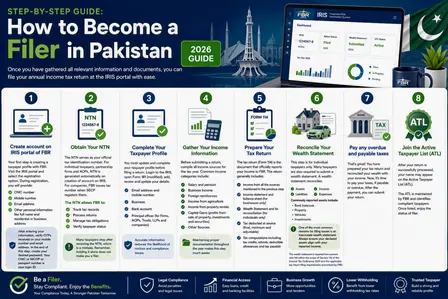
Once you have gathered all relevant information and documents, you can file your annual income tax return at the IRIS portal with ease.
Step 1: Create account on IRIS portal of FBR
Your first step is creating a taxpayer profile with FBR. Visit the IRIS portal and select the registration option. During registration, you will provide:
- CNIC number
- Mobile number
- Email address
- Other personal information like full name and residential or business address
After entering your information, verify OTPs received on your mobile number and email address. In the end of this step, create your desired password. Your CNIC or NICOP or passport number is your login ID.
Step 2: Obtain Your NTN
The NTN serves as your official tax identification number. For individual taxpayers, partnership firms and AOPs, NTN is generated automatically on creation of account on IRIS. For companies, FRB issues tax number when SECP registers them.
The NTN allows FBR to:
- Track tax records
- Process returns
- Manage tax obligations
- Verify taxpayer status
Many taxpayers stop after receiving the NTN, which is a mistake. Remember, holding it alone does not make you a filer.
Step 3: Complete Your Taxpayer Profile
You must update and complete your taxpayer profile before filing a return. Login to the IRIS, open Form 181 (modified); add, review and update your details:
- Email address and mobile number
- Business
- Bank account
- Principal officer (for Firms, AOPs, Trusts, LLPs and companies)
Accurate information reduces the likelihood of notices and compliance issues.
Step 4: Gather Your Income Information
Before submitting a return, compile all income sources for the tax year. Common income categories include:
- Salary and pension
- Business Income
- Foreign remittances
- Income from agriculture
- Income from property rentals
- Capital Gains (profits from sale of property, investments and securities)
- Other Sources
Maintaining proper documentation throughout the year makes this step much easier.
Step 5: Prepare Your Tax Return
The tax return (Form 114) is the document that officially reports your income to FBR. The return generally includes:
- Income from all the sources mentioned in the previous step
- Income statement and balance sheet (for businesses only)
- Wealth Statement and its reconciliation (for individuals only)
- Tax deducted at source (final, minimum and adjustable)
- Tax computations including tax credits, refunds, deductible allowances and tax payable
Step 6: Reconcile Your Wealth Statement
This step is for individual taxpayers only. Many taxpayers are also required to submit a wealth statement. A wealth statement reconciles:
- Assets
- Liabilities
- Income
- Expenses
Commonly reported assets include:
- Bank balances
- Property
- Vehicles
- Investments
One of the most common reasons for filing issues is an inaccurate wealth statement. Always ensure your declared assets align with your reported income.
The wealth statement is required from persons who fall within the scope of Section 116 of the Income Tax Ordinance 2001 and the applicable tax return filing requirements prescribed by FBR
Step 7: Pay any overdue and payable taxes
That’s great! You have prepared your tax return and reconciled your wealth with your income. Now, it’s time to pay your taxes, if payable or overdue. After the payment, you can submit your return.
Step 8: Join the Active Taxpayer List (ATL)
After your return is successfully processed, your name may appear on the Active Taxpayer List (ATL). The ATL is maintained by FBR and identifies compliant taxpayers. Once listed, enjoy the status of filer.
How to File Your Income Tax Return on IRIS 2.0
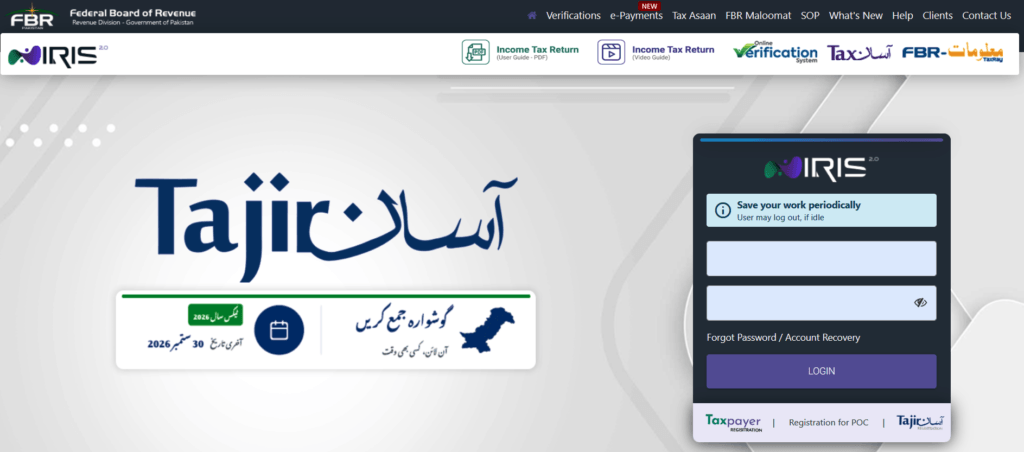
Before you start to file your income tax return, draft all your numbers in an excel workbook. A sheet should have your assets and liabilities and other should have reconciliation between your inflows (income and increase in wealth) and outflows (expenses and decrease in your wealth).
Now, login to IRIS 2.0. Open Form 114 from the declaration tab of the dashboard. For the tax return of FY 2025-26, FBR prefills your income and taxes which are already reported by your employer or suppliers (if you are doing business).
For a resident individual, wealth statement is mandatory to submit. It reports your assets and liabilities as at 30th June of the previous tax year and current tax year. Your wealth statement must be reconciled.
Pro tip: Just to become filer, taxpayers file their returns in a hurry. Don’t do this. Match increase in your wealth with an increase in your income and inflows. It is quite logical. In case of nil return or underdeclared assets, you can get a notice of discrepancy under the section 114 or 122.
Note: Wealth statement works on the accounting principles which are behind the balance sheet and income statement.
Adjustable and refundable taxes
Before submission of your tax return, you must know the adjustable taxes that reduce your tax liability. In fact, these taxes are deduced from you on your transactions.
- Cash Withdrawal from Bank under section 231AB.
- Advance Tax on registration, transfer, sale and lease of Motor Vehicles under section 231B.
- Advance Tax on Foreign Domestic Workers under section 231C.
- Advance Tax on Motor Vehicles under section 234.
- Advance Tax on Electricity Consumption under section 235.
- Advance Tax at the time of Sale by Auction under section 236A.
- Advance Tax on Sale or Transfer of Immovable Property under section 236C.
- Advance Tax on Functions and Gatherings under section 236CB.
- Advance Tax on Sales to Distributors, Dealers and Wholesalers under section 236G.
- Advance Tax on Sales to Retailers under section 236H.
- Advance Tax on Purchase or Transfer of Immovable Property under section 236K.
- Advance Tax on Amounts Remitted Abroad through Credit, Debit and Prepaid Cards under section 236Y.
Deadline for submission of Income Tax Return for FY 2025-26
- AOP and individuals – 15-Oct-2026
- Companies – 31st December 2026
The Board has authority to increase the deadline.
ATL Surcharge and Penalties for late filing
If taxpayers file their returns after the due dates, the ATL surcharges are:
- Individuals – Rs. 25,000/-
- AOPs and Partnership firms – Rs. 50,000/-
- Companies – Rs. 100,000/-
For missing deadlines, a taxpayer can face:
- Penalty under Section 182 (0.1% of tax payable)
- Removal from Active Taxpayers’ List
- Default surcharge under Section 205 for any unpaid tax
How to Check Your Filer Status
You can check your active status by SMS, online verification and Tax Asaan app.
- SMS: Type your CNIC (without dashes) and send the text msg to 9966.
- Online verification: Go on IRIS 2.0 portal, scroll down its home page to find verification window and enter CNIC or NTN to find your status at your desired date.
- Tax Asaan App: Install tha App. Go to FBR verification and enter your NTN or CNIC, as the case may be, to confirm the filer status.
How Long Does It Take to Become a Filer?
Just 24 hours after return submission and payment of ATL surcharge (if applicable), you become an active taxpayer.
For FY 2025-26, if you submit your tax return before 15th October 2026, the Board will not ask for payment of ATL challan. And you will be appearing on the list in the very next day.
Submission of tax return after the due date will not make you filer until you pay ATL challan of Rs. 25,000/-. Before the Federal Budget 2026, it was only Rs. 1,000 for individuals.
Common Mistakes New Filers Make
Many first-time taxpayers encounter avoidable problems.
- Assuming NTN Means Filer Status
- Ignoring reconciliation of wealth statements
- Missing deadlines of submission of your return
- Incorrect income reporting
- Forgetting to add and update bank accounts
- Not declaring al your assets
Expert Tips and Best Practices
- File early and don’t wait for deadlines. The fiscal system breaks down in August and September.
- Keep records of your income, assets, expenses and liabilities in any format whether digital or printed.
- Keep your wealth statement reconciled. Mismatches between wealth and income can trigger FBR audit notice.
- If you have multiple sources of income, frequent trading of shares or properties or you did not file previous tax returns, it is recommended to consult a tax professional rather self-filing.
What Happens After You Become a Filer?
Becoming a filer is not a one-time activity. You must continue filing annually to maintain active taxpayer status.
Ongoing Responsibilities
- Keep Records: Maintain documentation for income, expenses, bank accounts and investments.
- File Returns on Time: Timely filing helps preserve ATL status.
- Update Taxpayer Information: Keep personal and business details current.
- Respond to Tax Notices: Address any FBR correspondence promptly.
Latest 2026 Updates
IRIS 2.0 is now getting data from stock exchange, banks, excise department, cantonment boards and development authorities for cross verification of assets like stocks, saving accounts, vehicles, house, flats and plots.
Just like 2024 and 2025, FBR is actively targeting businesses to go for digital invoicing and the integration of businesses with FBR for this purpose. So, Commissioner can get real time insights on sales and sales tax. Read our complete guide on digital invoicing.
The Federal Budget 2026 has set framework for using AI in analysis, risk profiling and noticing. It will bring transparency.
The Board has also Increased rates of ATL surcharges which I have discussed in previous section. The Form 114 (Income tax return) has also updated. Extra fields have been removed. When you enter your salary, it asks for details of employer. When you enter rental income, it asks for the details of property to be entered.
Final Thoughts
Becoming a filer in Pakistan is no longer a complicated process reserved for accountants and large businesses. With online registration, digital filing systems, and streamlined compliance procedures, most individuals can begin the process with basic documentation and accurate financial information.
The real advantage of filer status extends beyond reduced withholding taxes. It strengthens your financial profile, supports long-term compliance, and helps you avoid unnecessary taxation on major transactions.
If you’re a salaried employee, freelancer, consultant, e-commerce seller, or business owner, the best time to organize your tax affairs is before deadlines arrive.
The sooner you register, file correctly, and secure your place on the Active Taxpayer List, the sooner you can enjoy the benefits of being a compliant taxpayer in Pakistan.
Ready to become a filer?
Let our tax experts handle the process.
Legal references:
- Income Tax Ordinance 2001 (updated 2026) and relevant SROs
- Federal Finance Act 2026
Disclaimer:
This article is intended for general information and educational purposes only. Tax laws, tax rates, filing requirements, due dates, and ATL surcharge provisions may change through annual Finance Acts, SROs, and FBR notifications. Readers should consult the latest legal provisions or seek professional advice before making any tax-related decision.
Need help becoming a filer? ConSerIC Accountants can assist with NTN registration, tax return filing, ATL activation, freelancer tax compliance, and business tax advisory services across Pakistan.
Frequently Asked Questions
Is NTN the Same as Filer Status?
No. An NTN is your tax identification number. Filing a tax return and appearing on the ATL makes you a filer.
Can a Student Become a Filer?
Yes. If necessary, a student can register and file returns.
Do Freelancers Need an NTN?
Freelancers often need tax registration to ensure compliance and facilitate return filing.
How Much Does It Cost to Become a Filer?
Government registration itself is generally completed through FBR systems. Professional service charges vary depending on complexity.
Can I Become a Filer Without Significant Income?
In some situations, individuals may still choose to register and file returns for compliance purposes.
How Often Must Returns Be Filed?
Income tax returns are generally filed annually.