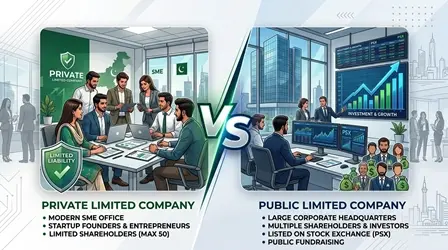
This blog presents the most common statutory and legal requirements for public limited companies in Pakistan.
The Securities and Exchange Commission of Pakistan (SECP) regulates corporate sector and capital market of Pakistan. PSX (Pakistan Stock Exchange), NCCPL (National Clearing Company of Pakistan Limited) and CDC (Central Depository Company) complements the Commission in fulfilling its responsibilities.
Table of Contents
- Statutory requirements for Public Companies
- Minimum shareholders and directors’ requirement:
- Appointment of CEO
- Appointment of Company Secretary
- Certificate of commencement of business (COCB)
- Registered Office
- Annual General Meeting (AGM)
- Holding a Statutory Meeting
- Auditor Appointment
- Filing of Annual return with SECP
- Filing of financial statements
- Statutory register
- Corporate Governance Requirements for listed companies
- Initial Public Offerings (IPO) basic requirements
- Conclusion
- Disclaimer
- Legal References
This blog splits its content into:
- Statutory requirements under the Companies Act 2017 and the Companies regulations
- Basic structure of Board of Directors
- Basic requirements of IPO
Let’s take a look at them one by one.
Statutory requirements for Public Companies
Below requirements make the base of compliances for a public company whether it is listed or un-listed. It covers structure of board of directors, commencement of commercial operations, appointment of officers, maintaining records, holding meetings and SECP annual filing etc.
Minimum shareholders and directors’ requirement:
| Sr. No. | Company | Minimum Directors |
| 1 | Public unlisted company | 3 (three) |
| 2 | Public listed company | 7 (seven) |
A public company requires at least 3 shareholders for registration. Also note:
- Director must be shareholder.
- The requirement of shareholding for CEO of a public company is not necessary. A non-shareholder can be appointed as director.
Appointment of CEO
A public company must appoint:
- First CEO at incorporation.
- Subsequent CEO appointments by the Board (after tenure of 3 years).
CEO particulars must be reported to SECP through Form-9.
Appointment of Company Secretary
Every public company must appoint a Company Secretary. A secretary may be:
- ICAP member;
- ICMAP member;
- Chartered Secretary or Corporate Secretary;
- MBA, M.Com, Law Graduate with prescribed experience;
- Certain retired government officers.
The company secretary ensures legal compliances of a public company.
Certificate of commencement of business (COCB)
A public company cannot commence business or exercise borrowing powers until:
- Minimum subscription received.
- Directors pay for their shares.
- Filing of Form-22 (declaration of a public company before commencing business) is filed to registrar and it is approved by the registrar.
The Form -22 is filed right after the registration of the company. Only after getting COCB, it can start its commercial operations legally.
Registered Office
A public company must maintain registered office.
The registered office address can be reported at time of incorporation. But if, it has not been arranged, company can notify it within 30 days of incorporation.
Annual General Meeting (AGM)
Every public company must hold AGM annually. Key matters typically include:
- Adoption of financial statements.
- Auditor appointment.
- Election of directors (where applicable).
- Dividend matters.
Holding a Statutory Meeting
Holding an AGM is annual requirement.
Public companies are required to hold a statutory meeting and file a statutory report. This meeting will be held with earlier of:
- Within 180 days of issuance of COCB; or
- 9 months of incorporation
The requirement of statutory meeting is only applicable on public companies. At the statutory meeting, the founders of public company discuss the matters listed in Section 131 of the Companies Act 2017 and; purpose, vision and future plans of the company.
After holding the statutory meeting, the public company will file Form-25 (along with the statutory report) with the registrar.
Auditor Appointment
Public companies must appoint auditors annually. Unlike individuals, partnerships and private company (subject to a threshold), it is required to appoint a statutory auditor under the Companies Act 2017.
Auditor details are reported through Form-9.
Filing of Annual return with SECP
Off course, annual filing of Form-A is also necessary.
Filing of financial statements
The company must:
- Prepare financial statements.
- Arrange their audit.
- Lay them before AGM.
- File them with SECP within prescribed time.
Reporting of Ultimate Beneficial Ownership (UBO)
It is also mandatory to:
- Identify UBOs.
- Obtain declarations from members.
- Maintain UBO Register.
- File Form-19 annually along with Form-A.
UBOs are the natural persons who exercise ownership or control a company through at least 25% shareholding or voting rights.
Statutory register
The company secretary will ensure the proper maintenance of registers of:
- Directors
- CEO
- CFO
- Company Secretary
- Auditors
- Legal Adviser
Corporate Governance Requirements for listed companies
When a public company moves towards listing, it has to implement corporate governance. Below are the requirements of corporate governance for the listed companies.
Board Composition Requirements
| Sr. No. | Directors | Minimum number |
| 1 | Independent directors | At-least 2 or one third of BOD whichever is higher |
| 2 | Female director | At least 1 (one) |
| 3 | Executive directors including CEO | Executive directors, including the CEO, cannot exceed one-third of BOD. |
Chairman and CEO must be separate.
Board responsibilities
The Board is responsible for:
- Corporate governance oversight
- Internal control environment
- Risk management framework
- Ethical conduct
- Strategic direction
- Monitoring management performance
The Board should maintain:
- Vision and mission statement
- Corporate strategy
- Code of conduct
- Internal control systems
- Annual Board performance evaluation mechanism
Initial Public Offerings (IPO) basic requirements
Before listing and getting enrolled in IPO, the board of directors has to consider the fundamentals of offerings. In the coming lines, I am explaining these basics.
Type of offerings
| Sr. No. | Securities | Types |
| 1 | Equities | Ordinary and preference shares |
| 2 | Debt securities | Term finance certificates, sukuks, commercial papers and convertible bonds |
| 3 | Others | REITs, SPAC offerings and GEM market offerings |
Initial Readiness for IPO
- SECP pending forms have been filed like Form A, Form 9, UBOs, and audited accounts.
- Board approval
- Company must have profits for at least 2 preceding financial years
- At least 51% shareholding must have been held by the same persons for the preceding two years in applicable cases.
- The issuer, sponsors, directors and substantial shareholders should not be loan defaulters in CIB.
- For IPO, company must appoint consultant to the issuer, underwriter, share registrar, balloter and banker to the issue.
- Company will issue prospectus.
IPO methods
| Sr. No. | Methods | How does it work |
| 1 | Fixed Price | Offer price is fixed before subscription. Prospectus must contain a Valuation Section. DCF, DDM and GGM valuation methodologies may be used. The entire issue must be underwritten. |
| 2 | Book building | It follows Dutch auction method. Floor Price set by issuer. Price Band is established. Bidders compete electronically. Strike Price is discovered through bidding. Up to 75% allocation may be made to book building investors. At least 25% is allocated to retail investors. |
For larger IPOs, book building method is used.
An overview of prospectus
| Sr. No. | Parts of prospectus | Contents |
| 1 | Corporate information | History, business model, products, services and industry overview. |
| 2 | Share capital | Exiting capital, post-IPO capital and sponsor holdings. |
| 3 | Financial information | Audited accounts, financial ratios and projections. |
| 4 | Governance | Directors, CEO, CFO, senior management and audit committee. |
| 5 | Legal matters | Litigation, overdue loans and regulatory actions |
| 6 | Valuation of business and assessment of risks | Risks like business, project, financial and regulatory. |
| 7 | Why IPO is needed | New business venture, existing business extension etc. |
After IPO
Sponsors must retain their shareholding for 12 months and must maintain minimum 25% of paid-up capital for a prescribed time period. After listing, the issuer must report use of IPO proceeds in:
- Quarterly reports
- Half-yearly reports
- Annual reports
Conclusion
Due to the public interest and money involved, the public companies are subject to regulations of SECP, stock market and others.
Disclaimer
This blog is for informational and educational purpose only and it does not constitute any legal opinion or a professional advice. Laws and regulations may change over time. So, we don’t accept any responsibility for any decision taken on the basis of the content of this blog / web page. It is recommended to consult a professional for your compliance matters.
Legal References
- Companies Act 2017
- Companies Regulations 2024
- Securities Act 2015
- Public Offering Regulations 2017
- Code of Corporate Governance issued by SECP