Updated: 3 September 2026
The Third Schedule of the Sales Tax Act 1990 enlists specific goods on which sales tax is charged on the retail price instead of the transaction value.
Section 3(2)(a) of the Sales Tax Act requires manufacturers and importers of these goods to print retail prices along with sales and final retail prices on the products.
For Third Schedule products:
- GST is generally charged at 18%.
- Manufacturers and importers bear special compliance responsibilities.
- FBR closely monitors these goods because they are mass-consumer products.
Why Did FBR Create the Third Schedule?
Primarily, the Third Schedule was introduced to keep the retail prices of households and consumers goods in control. It also prevented under-invoicing and fake input claims in consumer markets.
By taxing the retail price:
- Tax collection becomes more predictable for FBR.
- Under-declaration is not easy.
- FBR captures sales tax closer to the consumer market value.
What is Retail Price under the Sales Tax Act 1990?
The Section 2(27) of the Sales Tax Act 1990 defines retail price. Manufacturer or importer (in case of imported goods) fixes retail price. This price includes:
- Cost incurred to manufacturer for making the finished product
- Margin of manufacturer
- Cost incurred to importer for importing it
- Margin of importer
- All the duties, charges and taxes paid by manufacturer or importer
But the retail price dose not include sales tax (GST). Once, the price has been fixed, then the sales tax is charged on it. End user gets the product at price including sales tax.
I am explaining calculation of sales tax in the coming section.
How Is GST Calculated on Third Schedule Items?
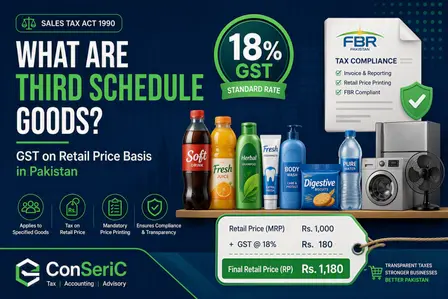
For Third Schedule goods, GST is applied to the retail price printed on the product.
For example: Suppose, for a product:
- Printed Retail Price = Rs. 1,000
- GST Rate = 18%
- GST = Rs. 180
- Total Price to Consumer = Rs. 1,180
Manufacturer or importer will print retail price like this – 1,000 (MRP) + 180 (ST) = 1,180 (RP) whereas, MRP is retail price fixed by the manufacturer or importer, ST is the sales tax and RP is the final retail price paid by the end consumer.
For these goods, it is a market norm that the importer or manufacturer supplies the goods to distributor at rates lower than retail price. So, an end user can get them at the printed retail price.
The sale tax remains the same through-out the supply chain.
The Section 2(46) of the Sales Tax Act is the base of this calculation. It explains “value of supply” which is foundation of GST.
Who Must Comply with Third Schedule Rules?
The primary compliance burden falls on manufacturers and importers of Third Schedule goods. They must:
- Mention MRP, GST and final retail price on the products.
- Issue valid sales tax invoices.
- Maintain sales records.
- Ensure correct reporting in sales tax returns.
Failure to comply can result in penalties, disallowances of input tax, holding refunds of sales tax or audits by FBR.
What Products Are Included in the Third Schedule in 2026-27?
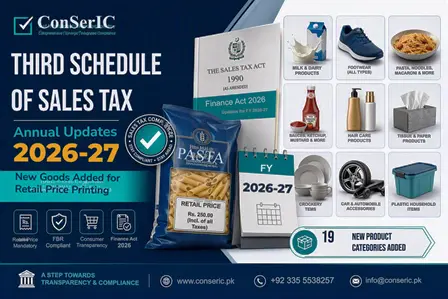
The Third Schedule has expanded significantly over time. Under the Finance Act 2026, many most commonly used consumer products have been included in its scope.
Let’s take a look at these items:
| Sr. No. | Categories | Consumer products |
| 1 | Beverages and Food Products | Fruit juices, vegetable juices, ice cream, aerated beverages, soft drinks, syrups, squashes powder drinks, milky drinks, tea, imported coffee, mineral water, bottled water, biscuits, pasta, macaroni, noodles, sugar confectionery, sauces, ketchup, chocolates, cereal bars, jams and marmalades. |
| 2 | Tobacco Products | Cigarettes |
| 3 | Personal Care and Cosmetics | Toilet soaps and other cleaning products, detergents, shampoo, toothpaste, shaving cream, perfumes, cosmetics, hair preparations, personal deodorants and tissue paper. |
| 4 | Household Goods | Household electrical appliances, air conditioners, televisions, refrigerators, deep freezers, electric fans, electric irons, washing machines, gas appliances, furniture-related products, crockery items, plastic household items, utensils, ceramic products and bathroom accessories |
| 5 | Footwear and Lifestyle Products | Footwear sold through retail channels, travel bags, suitcases, wallets, handbags, fashion accessories and similar consumer products. |
| 6 | Automotive Products | Motorcycles, auto-rickshaws, retail-packed auto parts, vehicle fluids, storage batteries, tyres and tubes. |
| 7 | Construction and Building Materials | Cement sold in retail packing, tiles, paints, distempers, enamels, varnishes, pigments, resins and related retail construction products. |
We have also published a dedicated webpage on the complete list and HS codes (PCT headings) of these items. HS codes are used to identify any product across the supply chain from manufacturer or importer to retailer.
Are Imported Products Also Covered?
Yes, many imported goods are included in the Third Schedule. Examples include:
- Coffee
- Chocolates
- Cereal bars
- Pet food
- Cosmetics
- And many others
What Happens If Retail Price Is Not Printed?
Failure to print retail price correctly can trigger significant tax and penalty exposure. Under the Section 33 of Sales Tax Act:
- Products may become liable to confiscation.
- Penalty of Rs. 10,000 or 5% of the sales tax (or higher amount) may be imposed.
- Additional penalty can be charged for continued default.
- The Commissioner Inland Revenue may challenge reported sales tax calculations.
For this reason, manufacturers and importers must carefully manage labeling and packaging compliance.
What are the common issues a retailer may face while filing sales tax returns?
Common issues include:
- POS is not integrated with FBR (mandatory for Tier-1 retailers)
- Putting wrong HS code while uploading sales invoices to the sales ledger in Invoice management module of IRIS system
- Unregistered suppliers (input tax can’t be claimed)
Conclusion
Due to chargeability of sales tax on retail price basis, the third schedule Items are among the most misinterpreted ones in GST calculation in Pakistan. So, I believed to publish a dedicated blog on these goods. Hope so, you may have understood the concept ad calculation of sales tax for them.
In my practice of almost six years, for manufacturers and importers, understanding the Third Schedule is not an option. The correct product classification, retail price printing, accurate GST calculation and digital invoicing is necessary to reduce risks of FBR sales tax notes and audits.
As FBR continues expanding digital invoicing systems, businesses dealing in retail and consumer goods should review their compliance practices regularly and ensure that their invoicing system complies with digital invoicing rules.
Disclaimer:
The information provided in this article is for general educational and informational purposes only. It does not constitute a legal, tax, accounting, or any professional advice. The content is based on the provisions of the Sales Tax Act, 1990, as amended up to 30 June 2026, and related Sales Tax Rules 2006, SROs, notifications and circular issued by FBR.
The tax laws, FBR notifications, SROs, judicial decisions, and administrative interpretations may change over time. Readers should consult a tax professional when making business, tax, compliance, import, manufacturing, or pricing decisions
Legal References:
- Sales Tax Act 1990 (updated 2026-27)
- The Federal Finance Act 2026
- Salas Tax Rules 2006
- The relevant SROs, notifications and circulars issued by FBR